KG 통한 생성형 AI 리스크 완화

 Marko van Zwam
지식 그래프란 무엇인가요? (What is a Knowledge Graph?)
**지식 그래프(Knowledge Graph, KG)**는 관심 있는 도메인에서 지식을 연결하고 표현하는 수단입니다. 이는 그래프 구조를 사용하여 구축되며, 조직의 기존 데이터 소스를 기반으로 웹 규모로 데이터를 연결하여 구조화된 정보 및/또는 비구조화된 정보를 결합하는 것이 일반적입니다. 더 일반적으로 사용되는 관계형 데이터 모델과 달리, 그래프 모델은 개념 또는 엔터티와 이들 간의 관계를 수집하는 형태로 구축됩니다.
지식 그래프는 복잡한 데이터 및 메타데이터를 의미 있는 방식으로 연결하여 현대 데이터 분석의 기반을 형성합니다.
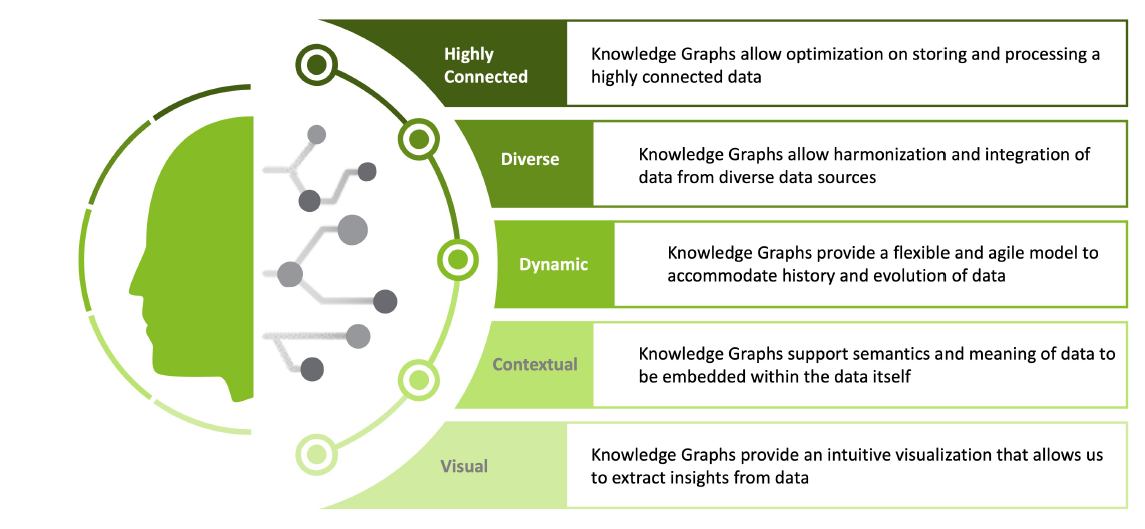
- 고도의 연결성: 지식 그래프는 고도로 연결된 데이터를 저장하고 처리하는 최적화를 가능하게 합니다.
- 다양성: 지식 그래프는 다양한 데이터 소스에서 데이터를 통합하고 조화를 이룹니다.
- 동적 변화: 지식 그래프는 데이터의 역사와 진화를 수용할 수 있는 유연하고 민첩한 모델을 제공합니다.
- 맥락성: 지식 그래프는 데이터 내에 의미와 의미론을 포함할 수 있도록 지원합니다.
- 시각화: 지식 그래프는 데이터를 통해 통찰력을 추출할 수 있는 직관적인 시각화를 제공합니다.
데이터 계보, 근본 원인 분석, 데이터의 360도 뷰, 컴플라이언스 및 데이터 품질 분석, 시간 경과에 따른 변경 추적, 영향 분석, 데이터 정제 및 마이그레이션, 추천(링크 예측), 메타데이터 관리, 의미 분석 및 추론, 엔터티 해상도, 의미론적 검색 및 쿼리 응답 등은 기업 내에서 지식 그래프의 몇 가지 사용 사례입니다.
toggle
A Knowledge Graph (KG) is a means to connect and represent knowledge in a domain of interest using a graph structure. It is typically built on top of existing data sources of an organization to link data together at web-scale, combining both structured and/or unstructured information. As opposed to the more commonly used relational data models, a graph model is built as a collection of concepts or entities and the relationships between them.
Knowledge graphs form the foundation of modern data analytics by connecting complex data and metadata in a meaningful way.
- Highly Connected: Knowledge Graphs allow optimization on storing and processing a highly connected data.
- Diverse: Knowledge Graphs allow harmonization and integration of data from diverse data sources.
- Dynamic: Knowledge Graphs provide a flexible and agile model to accommodate the history and evolution of data.
- Contextual: Knowledge Graphs support semantics and meaning of data to be embedded within the data itself.
- Visual: Knowledge Graphs provide an intuitive visualization that allows us to extract insights from data.
Data lineage, root-cause analysis, 360 view of data, compliance & data quality analysis, tracking changes overtime, impact analysis, data cleansing & migration, recommendation (link prediction), metadata management, semantics analysis & reasoning, entity resolution, semantic search and query answering are few use cases of knowledge graphs within companies.
논리적 추론 및 사고력 (Logical Inference and Reasoning)
지식 그래프는 그래프 내에 인코딩된 명시적 사실과 관계를 기반으로 새로운 결론을 도출하고 암묵적인 지식을 발견할 수 있게 합니다. 이는 일반적으로 **온톨로지(Ontology)**를 설계함으로써 달성되며, 온톨로지는 공유된 어휘와 데이터를 지식 그래프 내에서 상호 연관시킬 수 있는 규칙 집합을 정의합니다.
이러한 추론 및 사고력 기능은 지식 그래프를 추천 시스템 구축 및 복잡한 데이터 분석과 같은 작업에 특히 강력한 도구로 만듭니다. 이때 맥락과 관계를 이해하는 것이 중요합니다.
toggle
Knowledge graphs enable drawing new conclusions and discovering implicit knowledge based on the explicit facts and relationships encoded within the graph. This is typically achieved by designing a so called Ontology which establishes a shared vocabulary and a set of rules that dictate how data can be interrelated within the knowledge graph.
This capability for inference and reasoning makes knowledge graphs especially powerful tools for tasks such as building recommendation systems and complex data analysis, where understanding context and relationships is crucial.
지식 그래프가 생성형 AI의 리스크 완화에 어떻게 도움이 되는가? (How do Knowledge Graphs Help to Mitigate the Risks of Generative AI?)
지식 그래프는 비즈니스 맥락에서 생성형 AI의 신뢰성, 타당성, 투명성을 향상시킬 수 있으며, 이를 통해 기술적 및 규제적 리스크를 완화하여 혜택을 극대화할 수 있습니다.
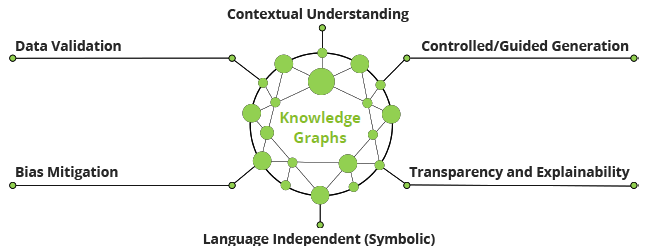
- 데이터 검증
- 맥락적 이해
- 통제된/유도된 생성
- 편향 완화
- 투명성 및 설명 가능성
- 언어 독립적(상징적)
toggle
Knowledge graphs can enhance the reliability, validity, and transparency of generative AI in a business context, helping to mitigate many of its technical and regulatory risks to maximize its benefits.
- Data Validation
- Contextual Understanding
- Controlled/Guided Generation
- Bias Mitigation
- Transparency and Explainability
- Language Independent (Symbolic)
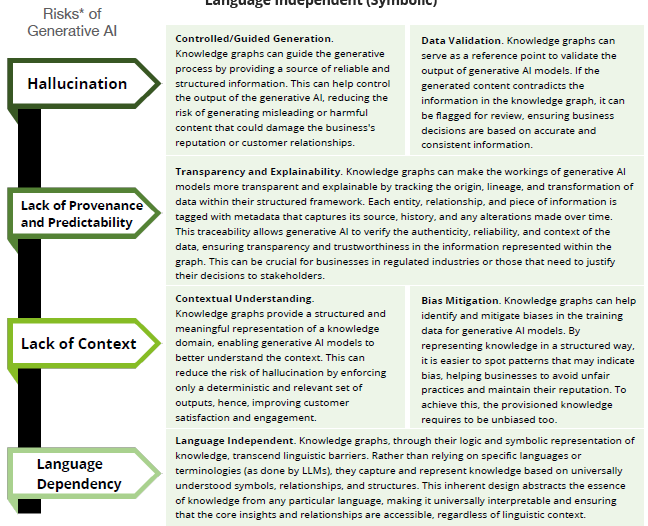
생성형 AI의 위험 (Risks of Generative AI)
- 환각 (Hallucination)
- 통제된/유도된 생성: 지식 그래프는 신뢰할 수 있는 구조화된 정보를 제공하여 생성 프로세스를 안내할 수 있습니다. 이는 생성형 AI의 출력을 제어하여 잘못된 또는 유해한 콘텐츠 생성을 줄여 비즈니스의 명성이나 고객 관계에 손상을 줄 수 있는 위험을 줄입니다.
- 데이터 검증: 지식 그래프는 생성형 AI 모델의 출력을 검증할 수 있는 기준점으로 사용될 수 있습니다. 생성된 콘텐츠가 지식 그래프의 정보와 모순될 경우, 검토를 위해 표시될 수 있어, 비즈니스 결정이 정확하고 일관된 정보에 기반할 수 있도록 보장합니다.
- 출처 부족 및 예측 불가성 (Lack of Provenance and Predictability)
- 투명성 및 설명 가능성: 지식 그래프는 생성형 AI 모델의 작동을 보다 투명하고 설명 가능하게 만들어 데이터의 출처, 계보, 변환 과정을 추적할 수 있습니다. 각 엔터티, 관계, 정보는 출처와 이력, 시간 경과에 따른 변경 사항을 캡처한 메타데이터로 태그가 지정됩니다. 이러한 추적 가능성은 생성형 AI가 데이터의 신뢰성, 진위성, 맥락을 확인할 수 있게 하여, 그래프 내 정보의 투명성과 신뢰성을 보장합니다. 이는 규제가 엄격한 산업에 속한 기업이나 의사 결정을 이해 관계자에게 정당화해야 하는 경우에 중요할 수 있습니다.
- 맥락 부족 (Lack of Context)
- 맥락적 이해: 지식 그래프는 지식 도메인의 구조화된 의미 있는 표현을 제공하여 생성형 AI 모델이 맥락을 더 잘 이해할 수 있도록 합니다. 이를 통해 결정론적이고 관련성 있는 출력 집합을 강제함으로써 환각의 위험을 줄이고 고객 만족도와 참여를 향상시킬 수 있습니다.
- 편향 완화: 지식 그래프는 생성형 AI 모델의 학습 데이터에서 편향을 식별하고 완화하는 데 도움이 될 수 있습니다. 지식을 비구조적으로 표현함으로써 편향을 나타낼 수 있는 패턴을 쉽게 발견할 수 있어, 기업이 불공정한 관행을 피하고 명성을 유지할 수 있도록 합니다. 이를 위해 제공되는 지식 또한 편향되지 않아야 합니다.
- 언어 의존성 (Language Dependency)
- 언어 독립성: 지식 그래프는 지식의 논리적 및 상징적 표현을 통해 언어적 장벽을 초월합니다. LLM(대형 언어 모델)에서와 같이 특정 언어나 용어에 의존하지 않고, 보편적으로 이해 가능한 기호, 관계, 구조를 기반으로 지식을 포착하고 표현합니다. 이러한 설계는 특정 언어로부터 지식의 본질을 추상화하여 보편적으로 해석 가능하게 만들며, 핵심 통찰력과 관계가 언어적 맥락에 관계없이 접근 가능하도록 보장합니다.
* "시의성 부족"의 경우, 새로운 사실이 등장하면 전체 모델을 재학습시키는 대신, 지식 그래프를 최신 정보로 업데이트할 수 있습니다. 이는 그래프에만 국한되지 않으며, 벡터 데이터베이스와 같은 기술로도 해결할 수 있습니다.
toggle
Risks of Generative AI
- Hallucination
- Controlled/Guided Generation: Knowledge graphs can guide the generative process by providing a source of reliable and structured information. This can help control the output of the generative AI, reducing the risk of generating misleading or harmful content that could damage the business's reputation or customer relationships.
- Data Validation: Knowledge graphs can serve as a reference point to validate the output of generative AI models. If the generated content contradicts the information in the knowledge graph, it can be flagged for review, ensuring business decisions are based on accurate and consistent information.
- Lack of Provenance and Predictability
- Transparency and Explainability: Knowledge graphs can make the workings of generative AI models more transparent and explainable by tracking the origin, lineage, and transformation of data within their structured framework. Each entity, relationship, and piece of information is tagged with metadata that captures its source, history, and any alterations made over time. This traceability allows generative AI to verify the authenticity, reliability, and context of the data, ensuring transparency and trustworthiness in the information represented within the graph. This can be crucial for businesses in regulated industries or those that need to justify their decisions to stakeholders.
- Lack of Context
- Contextual Understanding: Knowledge graphs provide a structured and meaningful representation of a knowledge domain, enabling generative AI models to better understand the context. This can reduce the risk of hallucination by enforcing only a deterministic and relevant set of outputs, hence, improving customer satisfaction and engagement.
- Bias Mitigation: Knowledge graphs can help identify and mitigate biases in the training data for generative AI models. By representing knowledge in a unstructured way, it is easier to spot patterns that may indicate bias, helping businesses to avoid unfair practices and maintain their reputation. To achieve this, the provided knowledge requires to be unbiased too.
- Language Dependency
- Language Independent: Knowledge graphs, through their logic and symbolic representation of knowledge, transcend linguistic barriers. Rather than relying on specific languages or terminologies (as done by LLMs), they capture and represent knowledge based on universally understood symbols, relationships, and structures. This inherent design abstracts the essence of knowledge from any particular language, making it universally interpretable and ensuring that the core insights and relationships are accessible, regardless of linguistic context.
* For the "lack of timeliness", when a fact emerges, instead of retraining the entire model, the knowledge graph can be updated with this fresh information. This isn't exclusive to graphs and can be also addressed by technologies such as vector databases.
예시 시나리오: 기술 지원 챗봇 (An Example Scenario: A Technical Assistant Chatbot)
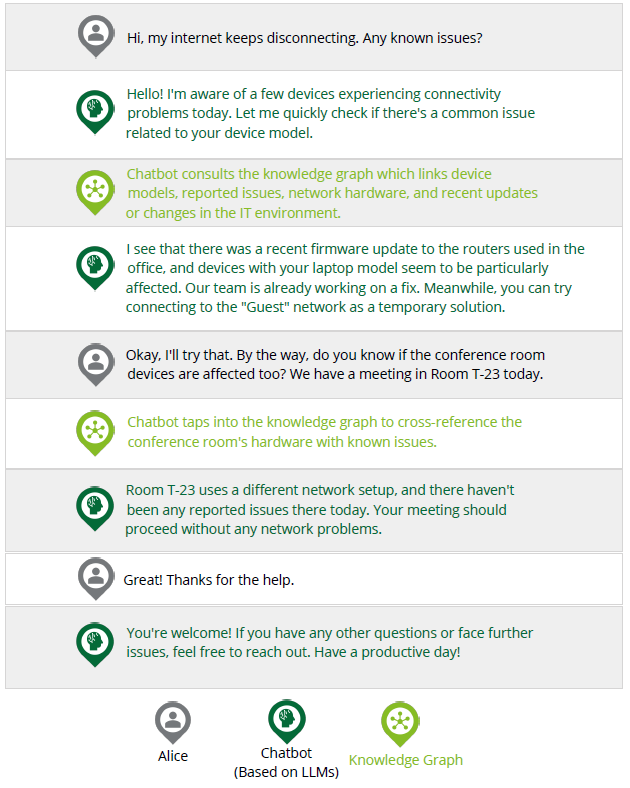
시나리오: 대기업 직원인 Alice가 회사 노트북에서 간헐적인 인터넷 연결 문제를 겪고 있습니다.
toggle
Scenario: Alice, an employee at a large corporation, is facing intermittent internet connectivity issues on her work laptop.
Alice: 안녕하세요, 제 인터넷 연결이 계속 끊겨요. 알려진 문제가 있나요?
챗봇: 안녕하세요! 오늘 몇몇 장치에서 연결 문제를 겪고 있다는 보고가 있습니다. 빠르게 확인해서 귀하의 장치 모델과 관련된 공통된 문제가 있는지 알아볼게요.
(KG: 챗봇이 장치 모델, 보고된 문제, 네트워크 하드웨어 및 최근 업데이트 또는 IT 환경의 변화를 연결하는 지식 그래프를 참조합니다.)
챗봇: 최근 사무실에서 사용 중인 라우터의 펌웨어 업데이트가 있었고, 귀하의 노트북 모델을 사용하는 장치들이 특히 영향을 받고 있는 것 같습니다. 저희 팀이 이미 해결 작업을 진행 중입니다. 그동안 임시 해결책으로 "Guest" 네트워크에 연결해 보실 수 있습니다.
Alice: 네, 그렇게 해볼게요. 그런데 혹시 회의실 장치들도 영향을 받았는지 아시나요? 오늘 T-23 회의실에서 회의가 있어요.
(KG: 챗봇이 회의실 하드웨어와 알려진 문제를 교차 참조하기 위해 지식 그래프를 참조합니다.)
챗봇: T-23 회의실은 다른 네트워크 설정을 사용 중이며, 오늘 그곳에서는 보고된 문제가 없습니다. 회의는 네트워크 문제 없이 진행될 것입니다.
Alice: 잘 알겠어요! 도와줘서 고마워요.
챗봇: 도움이 되어 기쁩니다! 다른 질문이 있거나 추가적인 문제가 발생하면 언제든지 문의해 주세요. 좋은 하루 되세요!
지식 강화 생성형 AI를 활용한 혁신 및 지식 관리 탐색 (Navigating Innovation & Knowledge Management Leveraging Knowledge-enriched Generative AI)
조직 전략의 역동적인 환경에서 기존 지식의 활용과 새로운 기회의 탐색 사이에서 균형을 맞추는 것이 중요합니다. 아래 매트릭스는 지식 그래프(KG)와 생성형 AI(genAI)의 사용 여부에 따라 다양한 전략적 입장을 설명합니다. 기술적 활용이 없는 전통적인 전략은 혁신 및 적응 능력을 저해할 수 있습니다. KG만 사용하는 경우, 기존 지식이 체계적으로 활용되어 데이터 기반 의사결정을 강화할 수 있지만 혁신적인 도약을 저해할 가능성이 있습니다. 반대로 genAI만 사용하면 혁신적인 아이디어 창출이 촉진될 수 있지만, 비구조화된 탐색과 전략적 불일치로 이어질 수 있습니다. KG와 genAI의 통합 응용은 기존 지식의 구조화된 활용과 새로운 영역에 대한 창의적 탐색을 결합하여 지식 기반 AI로 새로운 가능성을 열어주며, 기본적인 지식을 확보할 수 있도록 돕습니다. 실무자들에게는 KG의 구조화된 엄격함과 genAI의 유연한 탐색을 전술적으로 결합하는 것이 탄탄한 전략적 입지를 구축하는 길이 될 수 있습니다. 이 통합 접근 방식은 도메인 지식을 보호하고 새로운 전략적 개척지를 개척하는 동시에, 철저한 기술 통합과 숙련된 전략적 조정이 필요합니다. 이렇게 해야만 탐색과 활용 간의 긴장을 효과적으로 관리하면서 KG와 genAI의 시너지 잠재력을 최대한 활용할 수 있습니다.
toggle
Navigating Innovation & Knowledge Management Leveraging Knowledge-enriched Generative AI
In the dynamic landscape of organizational strategy, striking a balance between exploiting existing knowledge and exploring new opportunities becomes paramount. The below matrix delineates various strategic postures based on the use, or non-use, of knowledge graphs (KGs) and generative AI (genAI) to navigate this balance. Traditional strategies, often void of technological leverage, might impede innovation and adaptive capacities. Employing KGs alone can ensure that existing knowledge is methodically exploited, fortifying data-driven decisions, albeit potentially stifling innovative leaps. Conversely, utilizing genAI singularly might spur innovative ideation but can drift into unstructured and potentially misaligned explorations. An integrated application of both KGs and genAI into knowledge-enriched AI strives to synthesize the structured exploitation of existing knowledge with the inventive exploration of new terrains, potentially unlocking new horizons while securing foundational knowledge. For practitioners, tactically blending the structured rigidity of KGs with the explorative fluidity of genAI could pave the way towards a robust strategic stance, capable of both safeguarding existing domain knowledge and pioneering into new strategic frontiers. This integrative approach, while seemingly optimal, demands thorough technological integration and proficient strategic alignment to truly harness the synergistic potentials of KGs and genAI in managing the exploration-exploitation tension effectively.
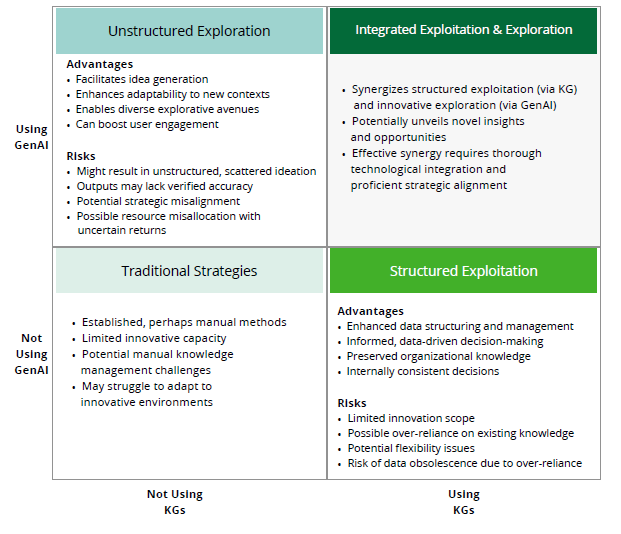
1/ GenAI 사용 + KG 사용
- 통합된 활용 및 탐색
- 장점:
- 구조화된 활용(KG를 통한)과 혁신적 탐색(GenAI를 통한)의 시너지
- 새로운 통찰력과 기회를 발견할 가능성
- 위험:
- 효과적인 시너지는 철저한 기술 통합과 숙련된 전략적 정렬이 필요
- 장점:
2/ Gen AI 사용 + KG 미사용
- 비구조화된 탐색
- 장점:
- 아이디어 생성 촉진
- 새로운 맥락에 대한 적응력 향상
- 다양한 탐색 경로 활성화
- 사용자 참여 증대 가능
- 위험:
- 비구조적이고 산발적인 아이디어 창출로 이어질 수 있음
- 출력물이 검증된 정확성을 결여할 수 있음
- 전략적 불일치 가능성
- 불확실한 수익을 가진 자원 오배치 가능성
- 장점:
3/ Gen AI 미사용 + KG 미사용
- 전통적 전략
- 장점:
- 확립된, 아마도 수동적인 방법
- 제한된 혁신 역량
- 수동적인 지식 관리 문제 발생 가능성
- 위험:
- 혁신적인 환경에 적응하는 데 어려움을 겪을 수 있음
- 장점:
4/ Gen AI 미사용 + KG 사용
- 구조화된 활용
- 장점:
- 향상된 데이터 구조화 및 관리
- 데이터 기반 의사결정 강화
- 조직 지식 보존
- 일관된 내부 결정
- 위험:
- 제한된 혁신 범위
- 기존 지식에 대한 과도한 의존 가능성
- 유연성 문제 발생 가능성
- 과도한 의존으로 인한 데이터 노후화 위험
- 장점:
지식 강화 생성형 AI를 구축하는 포괄적인 접근법
엔터프라이즈에서 지식 강화 생성형 AI를 구현하는 것은 여러 단계의 주요 단계를 포함합니다:
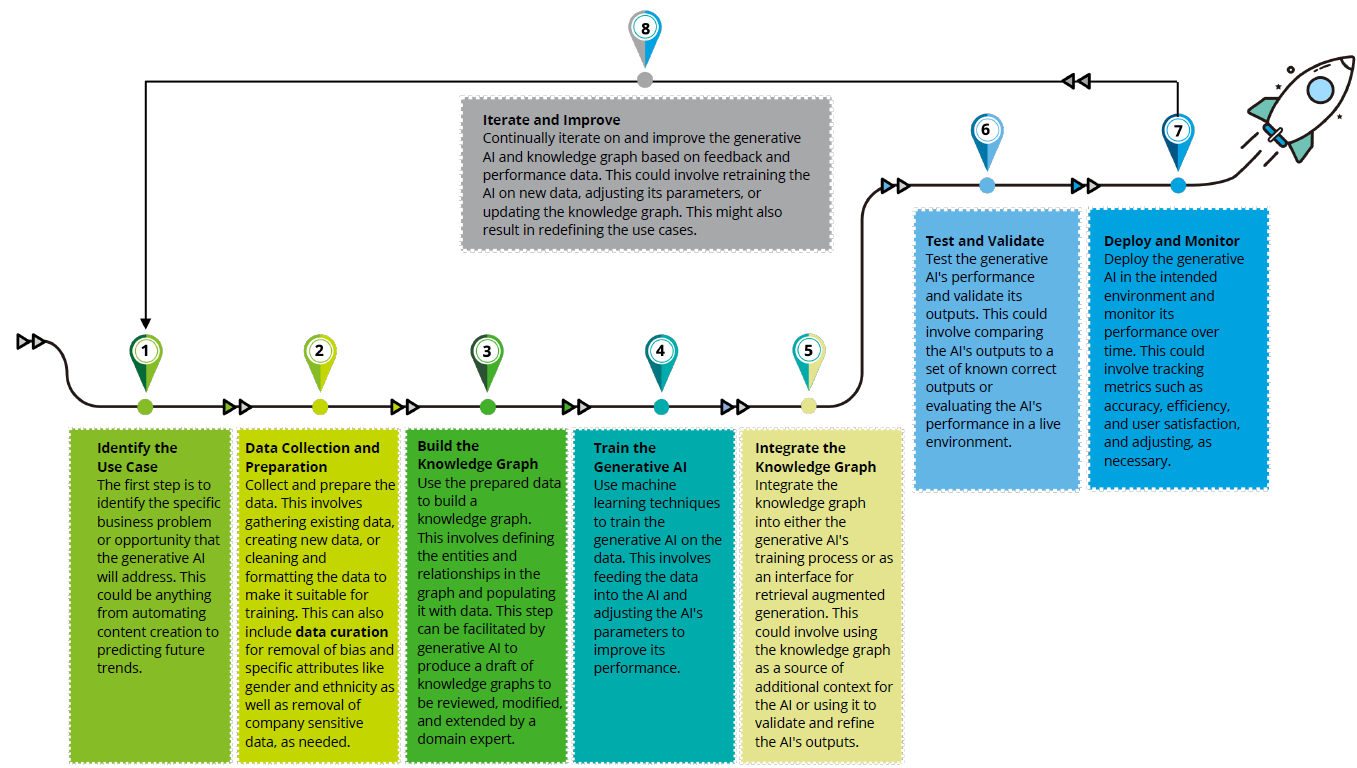
- 사용 사례 식별
비즈니스 문제 또는 해결할 기회 식별. 이는 AI가 해결해야 하는 특정 비즈니스 문제나 기회를 파악하는 것입니다. 여기에는 미래 예측 트렌드와 같은 문제를 예측하는 것이 포함될 수 있습니다. - 데이터 수집 및 준비
관련 데이터를 수집하고 이를 정제하여 AI 모델에 적합한 형식으로 준비합니다. 여기에는 성별 또는 민족 관련 편향을 제거하기 위한 데이터 정리가 포함될 수 있으며, 분석할 중요한 속성들을 정의하는 것도 포함됩니다. - 지식 그래프 구축
수집된 데이터를 사용해 지식 그래프를 만듭니다. 여기에는 관련 엔터티 간의 관계를 설정하고 지식을 그래프로 구성하는 작업이 포함됩니다. 생성형 AI를 통해 관계를 자동화할 수도 있습니다. 이 단계에서는 도메인 전문가의 검토가 필요할 수 있습니다. - 생성형 AI 훈련
준비된 데이터를 사용하여 생성형 AI를 훈련합니다. 이때 AI가 지식 그래프에서 데이터를 가져와 훈련되며, 모델 성능을 개선하는 데 중점을 둡니다. - 생성형 AI 통합
생성형 AI를 배포 및 통합하여 실시간으로 사용자가 상호작용할 수 있는 인터페이스를 구축합니다. 지식 그래프를 사용해 AI의 출력을 검증하고 필요에 따라 조정하는 추가적 컨트롤이 포함될 수 있습니다. - 테스트 및 검증
생성형 AI 모델의 성능을 테스트하고 AI의 출력을 검증합니다. 피드백과 성능 데이터를 기반으로 AI를 개선하고, 필요한 경우 조정 작업을 수행합니다. - 배포 및 모니터링
AI를 배포하고 실시간으로 모니터링하여 정확도, 효율성 및 안전성을 지속적으로 개선합니다. 필요한 경우 추가 조정 및 개선 작업을 수행합니다.
toggle
A Comprehensive Approach to Construct Knowledge-enriched Generative AI
Implementing a knowledge-enriched generative AI in an enterprise involves several key steps:
- Identify Use Case
Identify the specific business problem or opportunity that the implementation will address. This could be anything from automating content creation to predicting future trends. - Data Collection and Preparation
Collect and prepare the data that the AI model will learn from. This can involve data curation for removing bias and ensuring that the data is suitable for training. This can also include data curation for removal of bias and specific attributes like gender and ethnicity as well as removal of company-sensitive data, as needed. - Build the Knowledge Graph
Use the prepared data to build the knowledge graph. This involves defining the relationships in the graph and populating it with relevant information. This can be facilitated by generative AI to provide a draft of the graph that can be reviewed, modified, and enhanced by domain experts. - Train the Generative AI
Use the training data to feed into the AI and train the AI on how to use the knowledge graph. This involves feeding the data into the AI and adjusting the AI's learning model to improve its performance. - Integrate the Knowledge Graph
Integrate the knowledge graph with the generative AI. This involves creating an interface for generative AI systems that allows them to use the knowledge graph as a source of additional context for the AI or using it to validate and refine the AI's output. - Test and Validate
Test the generative AI's performance against the knowledge graph to ensure that the AI's outputs align with the knowledge graph. This also involves adjusting the AI's model to improve its accuracy and performance. - Deploy and Monitor
Deploy the AI in the intended business environment and monitor its performance over time. This could involve updating the knowledge graph to ensure accuracy, efficiency, and security as necessary.
The specific steps can vary depending on the specific use case, the type of generative AI being used, and the structure and content of the knowledge graph. It is also important to consider factors such as data privacy and security, AI ethics, and regulatory compliance throughout the implementation process.
지식 그래프가 생성형 AI로부터 얻을 수 있는 이점은 무엇인가요? (How can Knowledge Graphs Benefit from Generative AI?)
지식 그래프를 처음부터 구축하는 것은 시간과 노력이 많이 드는 작업입니다. 그러나 기업 환경에서 생성형 AI는 이러한 지식 그래프의 개발을 간소화하고 가속화하는 데 중요한 역할을 할 수 있습니다.
- 지식 그래프 채우기
지식 그래프를 채우는 경우, 생성형 AI는 텍스트에서 엔터티와 관계의 인스턴스를 추출하는 데 사용할 수 있습니다. 이를 위해 온톨로지나 스키마가 주어질 수 있습니다. - 그래프 완성을 위한 데이터 강화
그래프 완성을 위한 데이터 강화와 관련하여, 생성형 AI는 기존 구조와 내용을 기반으로 지식 그래프에서 새로운 노드와 관계를 생성하는 데 사용될 수 있습니다. 이를 통해 지식 그래프를 풍부하고 포괄적으로 만들 수 있습니다. 실제로 이 작업은 추가된 콘텐츠의 정확성을 보장하기 위해 검증이 필요할 수 있습니다. - 예측 분석
예측 분석의 경우, 생성형 AI는 과거 데이터를 기반으로 지식 그래프의 미래 상태를 예측하는 데 사용할 수 있습니다. 이는 전략적 계획 수립 및 비즈니스 컨텍스트에서 의사 결정을 위해 특히 유용할 수 있습니다.
toggle
Constructing a knowledge graph from the ground up is a time-intensive and effortful task. However, in an enterprise setting, generative AI can play a crucial role in streamlining and accelerating the development of these knowledge graphs.
- Populating a Knowledge Graph
When it comes to populating a knowledge graph, generative AI can be used to extract instances of entities and relationships from text, given an ontology or schema for the graph. - Data Enrichment for Graph Completion
With regards to data enrichment for graph completion, generative AI can be used to fill gaps in a knowledge graph by generating new nodes and relationships based on the existing structure and content of the graph. This can help to enrich the knowledge graph and make it more comprehensive. In practice, this task could involve vetting of the added content, to ensure its accuracy. - Predictive Analysis
For predictive analysis, generative AI can be used to predict future states of the knowledge graph based on historical data. This can be particularly useful for strategic planning and decision-making in a business context.
지식이 풍부한 LLM을 구현하는 방법: 아키텍처 디자인 (How to Realize Knowledge-enriched LLMs: Architectural Designs)
다음 섹션에서는 지식 그래프를 LLM과 결합하는 다양한 아키텍처 디자인을 소개합니다. 이들은 영감의 원천이 될 수 있지만, 조직의 고유한 요구 사항과 사양에 맞게 조정하는 것이 필수적입니다.
Option 1
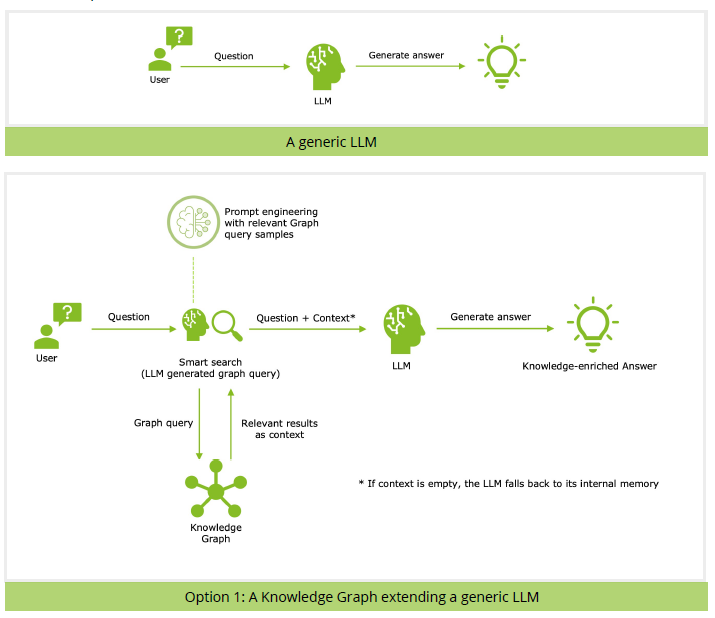
옵션 1은 **RAG(검색 증강 생성)**을 기반으로 하여 지식 그래프 기반 검색과 생성 기반 방법의 강점을 결합합니다. 단순히 처음부터 응답을 생성하는 대신, RAG는 먼저 그래프에서 관련 정보를 검색한 다음, 이 검색된 정보를 컨텍스트로 사용하여 상세하고 정확한 응답 생성을 유도합니다.
사용자의 자연어 쿼리를 그래프 쿼리로 변환하려면 대표적인 샘플 쿼리를 사용하여 프롬프트 엔지니어링을 수행해야 합니다.
지식 그래프의 정밀도와 생성 모델의 유연성을 결합함으로써 RAG는 더 정보에 기반하고 맥락을 고려한 출력을 제공하며, 또한 LLM의 시의성 부족 문제를 해결합니다.
이 방법은 LLM의 미세 조정 필요성을 제거하지만, 풍부해진 출력은 지식 그래프가 다루는 특정 도메인으로 제한됩니다.
toggle
In the following section, we introduce a variety of architectural designs that merge knowledge graphs with LLMs. While these serve as a source of inspiration, tailoring them to your organization's unique needs and specifications is essential.
Option 1 is based on Retrieval-Augmented Generation (RAG) to combine the strengths of both knowledge graph-based retrieval and generation-based methods in LLM. Instead of solely generating responses from scratch, RAG first retrieves relevant information from the graph and then uses this retrieved information as a context to guide the generation of detailed and accurate responses.
To convert user's natural language queries into graph queries, prompt engineering must be conducted using a set of representative sample queries.
By merging the precision of knowledge graphs with the fluency of generative models, RAG offers a more informed and contextually-aware output, also resolving the lack of timeliness of LLM.
While this method eliminates the need for fine-tuning the LLM, the enriched outputs are limited to the specific domain addressed by the knowledge graph.
Option 2
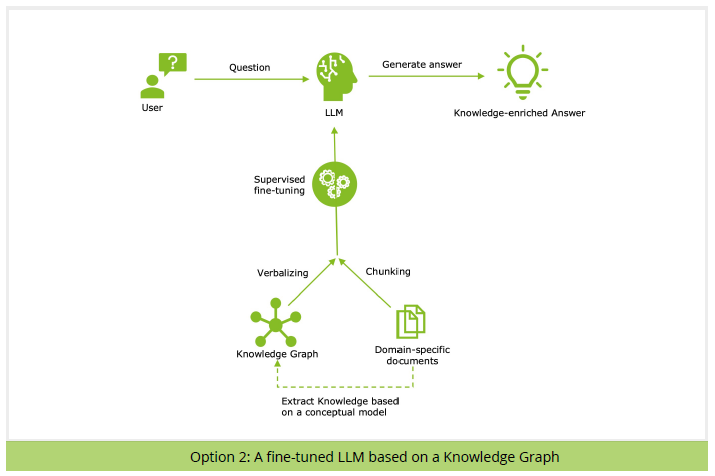
옵션 2는 감독된 미세 조정을 기반으로, 지식 그래프에서 추가적인 구조화된 지식을 받아들이는 LLM을 조정하는 방식입니다. 이는 지식 그래프를 언어화하는 작업을 요구하며, 즉 그래프 내의 구조화된 정보를 LLM이 소화할 수 있는 자연어 설명이나 내러티브로 변환하는 것을 의미합니다.
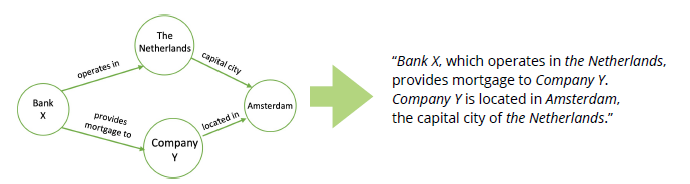
예를 들어, 다음의 네 개 엔터티와 네 개의 관계를 가진 그래프는 다음과 같이 언어화될 수 있습니다:
“은행 X는 네덜란드에서 운영되며, 회사 Y에 주택 담보 대출을 제공합니다. 회사 Y는 네덜란드의 수도인 암스테르담에 위치해 있습니다.”
이 접근 방식은 더 광범위한 주제를 포괄할 수 있지만, 정보가 업데이트될 때 LLM의 미세 조정이 필요한 비용이 발생합니다.
toggle
Option 2 is based on Supervised Fine-tuning of LLM with additional structured knowledge fed from a knowledge graph. This requires verbalizing the knowledge graph which means converting the structured information within the graph into some natural language descriptions or narratives, digestible by LLM.
For example, the following graph with four entities and four relationships can be verbalized into:
“Bank X, which operates in the Netherlands, provides mortgage to Company Y. Company Y is located in Amsterdam, the capital city of the Netherlands.”
This approach allows to encompass a wider range of topics, however, it comes with the costly fine-tuning of LLM when information is updated.
Option 3
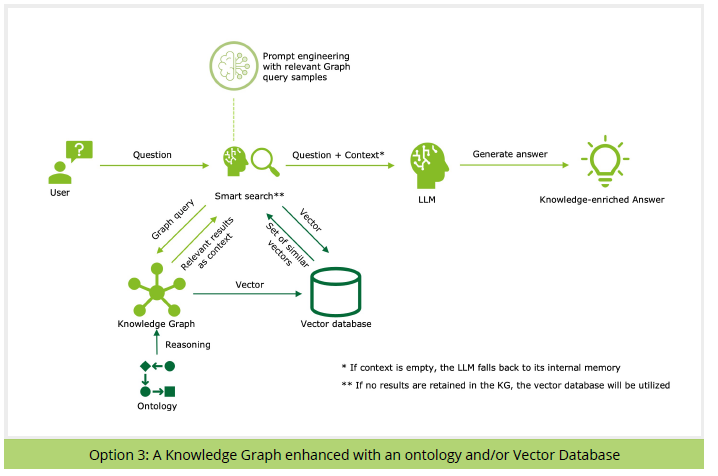
옵션 3은 옵션 1의 확장 버전으로, 벡터 데이터베이스가 추가되어 그래프 쿼리로 지식 그래프에서 직접 검색할 수 없는 더 많은 주제를 다룹니다. 지식 그래프는 엔터티 간의 관계와 의미론적 맥락을 명확히 나타내는 반면, 추가된 벡터 데이터베이스는 더 빠른 유사성 검색 기능을 제공하여 데이터 포인트 간의 미묘한 비교를 가능하게 하고 더 암시적이고 관련성 높은 결과를 제공합니다.
또 다른 확장 포인트는 생성된 출력의 깊이와 맥락적 정확성을 증폭시키는 의미론적 추론 기능입니다. 이를 위해 특정 도메인에서 지식을 나타내는 온톨로지를 설계해야 하며, 이는 엔터티, 그 속성, 그리고 엔터티 간의 관계를 개략적으로 설명함으로써 지식 그래프에 명시된 데이터 이상의 의미 있는 결론을 도출할 수 있게 합니다.
이 접근 방식은 향상된 범위, 더 깊은 의미론적 추론, 그리고 지속적으로 업데이트되는 종합적인 지식에 대한 접근을 제공하며, 동시에 LLM 미세 조정의 필요성을 제거합니다. 그러나 이는 데이터가 진화함에 따라 추가 데이터베이스를 유지하고 동기화해야 하는 과제를 도입합니다. 또한 추가 처리 시간, 온톨로지의 초기 개발 및 유지 관리, 그리고 추론 엔진 구현에 따른 비용을 고려해야 합니다.
toggle
Option 3 is an extended version of Option 1 where an additional vector database is added to cover for more topics that cannot get directly retrieved from the knowledge graph by running graph queries. While the knowledge graph explicitly depicts relationships and semantic context between entities, the added vector database provides faster similarity search capabilities, allowing for more nuanced comparisons between data points and providing more implicit and relevant results.
Another point of extension here is the capability of semantic reasoning to amplify the depth and contextual accuracy of the generated outputs. This requires designing an ontology that represents knowledge in a specific domain, outlining entities, their properties, and the relationships between them which allows the drawing of meaningful conclusions beyond explicit data in the knowledge graph.
This approach provides enhanced coverage, deeper semantic reasoning, and access to continually updated comprehensive knowledge, all while eliminating the need for LLM fine-tuning. However, it introduces the challenges of maintaining and synchronizing an additional database as data evolve. Additionally, there are considerations of added processing time, the initial development and upkeep of the ontology, and the associated expenses of implementing a reasoning engine.
결론 (Conclusion)
인공지능의 역동적인 분야를 탐색함에 따라 지식 그래프와 생성형 AI의 통합은 신뢰할 수 있고 책임 있는 기업 의사 결정을 가능하게 하는 변혁적 접근 방식으로 두드러집니다. 지식 그래프는 개념 또는 객체를 나타내는 엔터티와 그들 간의 관계를 명시적으로 정의하는 구조화된 지식 표현이 특징입니다.
지식 그래프는 명시적 사실을 포착할 뿐만 아니라 암묵적 지식의 추론을 가능하게 하는 의미론적 이해를 제공하는 신뢰할 수 있는 실질적인 지식 지도를 제공합니다.
반면에 생성형 AI는 텍스트, 이미지, 음악 또는 기타 형태의 데이터를 생성하는 능력으로 특징지어지며, 이는 학습 데이터에서 관찰된 패턴을 반영하거나 모방합니다. 이러한 두 강력한 영역을 결합하여 지식이 풍부한 AI 생태계를 구축하면 정확할 뿐만 아니라 맥락적 풍부함이 내재된 출력을 생성할 수 있습니다.
지식 그래프는 전용 학습 없이도 LLM과 같은 생성형 AI 모델의 행동에 일관되게 정확하게 영향을 미치고 안내할 수 있습니다. LLM이 매일 발전함에 따라, 지식 그래프는 최고 수준의 모델 전반에서 일관된 품질을 보장하는 수단을 제공합니다. 따라서 고품질의 엔터프라이즈 지식 그래프 개발에 투자하는 것은 사용 중인 특정 LLM과 관계없이 유익합니다.
이 백서는 지식이 풍부한 AI로의 여정의 시작에 불과합니다. 우리는 그 중요성을 다루고 실현을 위한 몇 가지 아이디어를 제시했지만, 앞으로 몇 년 동안 이 분야에서 더 많은 것이 펼쳐질 것입니다.
기술이 발전함에 따라, 깊은 지식을 가진 AI의 결합은 더 많은 혁신과 돌파구를 제공할 것입니다. 우리는 흥미로운 여정의 시작에 있으며, 앞으로 기대할 것이 많습니다...
toggle
As we navigate the dynamic field of artificial intelligence, the integration of knowledge graphs with generative AI stands out as a transformative approach to enable trustworthy and responsible enterprise decisions. Knowledge graphs are characterized by their structured representation of knowledge, where entities (often denoting concepts or objects) and the relationships between them are explicitly defined.
They provide a reliable and actionable map of knowledge to not only capture explicit facts but also enable semantic understanding, allowing for the deduction of implicit knowledge.
On the other hand, generative AI is characterized by its ability to produce new content, be it text, images, music, or other forms of data, that mirrors or emulates the patterns seen in its training data. Merging these two powerful realms into a knowledge-enriched AI ecosystem facilitates the production of outputs that are not only precise but imbued with contextual richness.
Knowledge graphs can consistently and accurately influence and guide the behavior of generative AI models such as LLMs, without the need for dedicated training. As LLMs continue to evolve daily, knowledge graphs offer a means to ensure consistent quality across top-tier models. Consequently, investing in the development of high-quality enterprise knowledge graphs is beneficial, irrespective of the particular LLM in use.
This Whitepaper is just the start of our journey into knowledge-enriched AI. While we have touched upon its importance and have come up with some ideas for its realization, there is much more to unfold in this domain in the upcoming years.
As technology advances, the blend of AI with deep knowledge will offer more innovations and breakthroughs. We are at the beginning of an exciting journey, and there is a lot to look forward to...